Saturday, January 29, 2011

Chili Bottles and Pottery Molds

Last week I went to make chili, and about half way through that process I went to the pantry to get the chili powder, and it wasn't there. It was at that moment I remembered watching the Sweetie drop and break the chili bottle, spilling the contents mixed with broken glass all over the floor about a month or so earlier. I had never replaced the chili powder.
For years we had a lot of bags and packages of various spices thrown into a box in a cupboard, because invariably when you buy a bag or package of spice it won't all go into the tiny spice bottles that come in the standard spice rack. Then one day I discovered little flip lid bottles at the Dollarama. They are perfect size to hold an entire spice package, which means I can eliminate the box of extra stuff in the cupboard. I bought about 30 of them, 2 for $1. Once I bought emergency chili powder for the chili I was making, I realized I didn't have any extra bottles in the pantry. Off I went this week to the Dollarama for more bottles.
Anyone who has visited a dollar store or similar establishment will understand when I say that I cannot leave there without buying more than I planned. I'm sure they rearrange the store so you always have to hunt for what you came to buy. While you are hunting, you invariably find loads of things you didn't know you needed. While I was hunting for spice bottles, several items leapt into my arms. (I never take a basket because I'm only there for one thing, which of course results in me dropping the arm load of stuff I'm carrying around the store while still looking for the thing I came for.)
Dollar stores are great places to find pottery stuff, because the best pottery stuff is cheap kitchen supplies. This week, in addition to spice bottles (this time 3 for $1) I bought several plastic and glass serving platters to use as molds in the studio. So far I have tried four of these with varied success.
One small square plate worked perfectly the first time. One larger square plate cracked as it dried too much before I took it off the mould. Twice. One round plate worked OK but it was pretty boring to look at. One oval platter got stuck on when I forgot to dust the clay with cornstarch beforehand, and then the same oval platter stuck again even though I remembered the cornstarch the second time. I still have two more bowls and two more platters I haven't yet attempted, but I think I will stop trying to use any of them directly and make plaster molds first.
Still, where else can you get a weekend of fun for under $20?

Sunday, January 23, 2011

The Joys of Winter - Seriously


Winter finally came. After rain and wind for the autumn straight through Christmas, January finally started looking and feeling like winter. I never used to like winter but I have discovered the joy of the season in the past few years.
1. No working. As a horticulturist snow and ice = time off.
2. New wardrobe. Long wool coats with matching or contrasting accessories, short jackets, a variety of sweaters, boots of every colour and height. By the time warm weather comes around I have forgotten what my summer wardrobe looks like and it is all new again too.
3. Shoe shoeing. I stay on top of the snow, the dog sinks giving her an extra workout without taxing my energy.
4. Storm days. I don't really need the excuse to stay home but I'll take an excuse anyway. This pine in our neighbours field cracked in a wind storm before Christmas, it got hung up on another pine, and they both came down Friday, our most recent windy, snowy day.
5. Sunny days. The sun on snow makes the house bright.
6. Curling. It's really just an excuse for different clothes, see item 2. But it also gives me some exercise and gets me out of the house except when item 4 gives me the excuse to stay home.
7. Books. Sadly the other three seasons keep me too busy to read for pleasure much, and I no longer can use public transit to go to work, so winter is reading time. I've been catching up, it's heavenly.
8. Birthday! It was last week, I got good loot and the sweetie made me gingerbread cake with whipped cream.
9. Pottery. I've been experimenting with form and technique again, and while that is producing another batch of mishmash without any coherence (again) I don't care, I'm having fun.
10. Garden Reading. Mostly magazines and websites and seed catalogues allowing me to plan and dream what I could do next year without the hassle of actually remembering how much work it all is.

Monday, January 3, 2011

How Gardeners Get Their Jollies

Happy New Year. We survived the season of Madness. It was good. Saw lots of friends, some from away, some from here but living away. Didn't over eat too much. Didn't get too much excessive stuff that we didn't need or want. The other one has been off since early December, and we have done some useful but mundane chores around the house over the past few weeks. Tonight, while tidying up my photos in the computer, I found some pictures of a gardening project I did last October and meant to write about but never had the time due to: work, craft fair madness, pre-Madness madness and just general all round madness.
It is still an experiment in progress, and finding the pictures made me go check on the actual experiment to see how it was getting along.So far so good, which is gratifying as I put a lot of work into this one.
Last October, I started taking apart the planters that the Town uses on the street in summer. One plant we always like to use for the planter boxes is ornamental sweet potato vine. They don't usually flower in Nova Scotia, but add interesting and full foliage to the planters. They come in lime green, bronze, and tricolour. I like the lime green ones the best, they really set off purple or blue flowered plants like heliotrope or verbena, and they are tough as nails for drought and wind and drunks. All of which we get on Main Street.
The down side is their price. A four inch plant retails for $4.99. I know we bought at least 54 last spring, that is $250+ just for one type of plant. They are expensive because they are grown by cuttings and our local nurseries can only buy plugs and pot them up because they are patented and you must pay a royalty to propagate them.
Last spring I put two lime green plants in each planter, and by fall they were huge trailing vines over the side of the boxes. As their name suggests, they make sweet potatoes. The lime green plants make pink ones. I'm not sure if they are edible, they are a cultivated variety selected as ornamentals and I imagine they are probably more starchy than tasty. But plants that produce storage organs like tuberous roots (as these are), true tubers, rhizomes, bulbs and corms do so as a method for surviving a season when growing conditions are not favourable for the plant. So it would stand to reason that I should be able to store the sweet potatoes and use them to grow plants again next spring. Last year, I saved some in my basement as an experiment. I treated them just like I treat Canna rhizomes. I brushed the soil off them, let them dry a bit and then stuck them in a box in the basement and forgot about them. This worked for the Cannas, but come spring, the sweet potatoes were wizened up and not one grew when I potted them up.
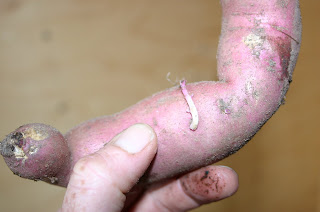
This year, I got scientific. I started researching how to save ornamental sweet potato vine on the Internet, and what I found was that it was all but impossible to do. Every gardening forum and website suggested that the tubers were useless but you could take a cutting in fall, root it in water and grow the plant as a house plant. A colleague at work tried this and it worked. Sweet potato vine roots easily just by sticking it in a jar of water. The problem with this, is that I want to save lots and lots. More than I have room to grow in my living room certainly.
And then there is my dirty little secret...I kill house plants. I am useless with plants indoors. I am aware of the irony. I cannot seem to keep a plant alive inside over the winter. Mostly because I forget to water it, and unlike the dog and cat, (and the sweetie for that matter) who will tell you that they are hungry, a plant will go to its death quite uncomplainingly.
Logically, and biologically, a plant would not put so much effort into producing a storage structure unless it was able to use it for survival. So I concluded that someone had figured out how to do this for the edible type of sweet potatoes, because after all we eat those in Nova Scotia all year round. I surmised that if I could duplicate the storage method for edible sweet potatoes, it would work for the ornamental ones as well.
I began by looking at agricultural websites and university research papers on sweet potatoes. I found a really good research paper by Paul Sumner at the University of Georgia (where else would you expect research on sweet potatoes?) It went into a lot of detail of how they commercially harvest and store sweet potatoes. I learned that I did everything wrong. Sweet potatoes need a warm humid curing environment for several days, followed by a cool moist storage environment. The paper is very specific about the temperatures and humidity and duration if you care to read about it at the link above. The problem is that it describes the commercial methods, with big specially built facilities with computer controlled environments. I needed to devise something that would do the same thing, for cheap on a small scale.
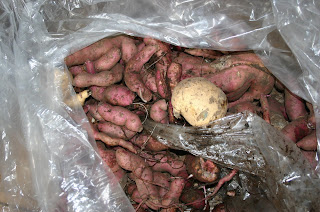
First, how to cure them at 28 degrees Celsius and 94% humidity? The humidity would come from putting them in a large plastic garbage bag. Their own moisture would keep the humidity high. The temperature was more of a problem, our house is a comfortable 18 degrees in summer most days because we are heavily shaded on the south and the house is super insulated with the windows shut. By October it is getting cooler outside but not so cool we want to light a fire or turn on the heat. At first I thought I should get an electric heating pad and cover them. The sweetie wasn't too keen on running a heating pad for 10 days continuous just for a crazy plant experiment. He came up with using the warm space on top of the fridge.
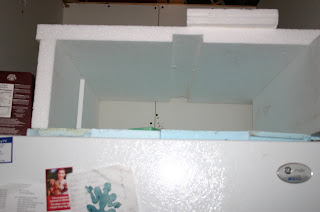
If you have room on top of the fridge it is good for all sorts. I have a friend that uses it to thaw frozen dinner rolls quickly. It is useful for rising bread dough, and I myself have used it to hasten germination of seedlings in spring. The compressor that cools the fridge has to expel heat somewhere, and usually it is out the back and rises to the ceiling. Even if the top of your fridge is not open, an enclosed cupboard above will be a few degrees warmer than the rest of the room.
The sweetie made a box out of 5 pieces of Styrofoam, 2 inches thick. We had this just lying around in the barn because we are in constant renovation mode and you never know when you night need some off cuts of Styrofoam. The bottom piece was square, roughly the size of the fridge top. The sides were 8 inches high, and hung out over the back of the fridge all the way to the wall. The top covered the sides to the wall also, and this way the heat got trapped into the insulated box. The front was cut to slot neatly into the rim made by the bottom top and sides, with a finger slot for opening. I was amazed to find that the temperature got up to 26 degrees Celsius in the box. The research paper suggested that a lower temperature would need a longer curing time, so I placed the sweet potatoes in the box and left them there for a two weeks instead of 10 days.
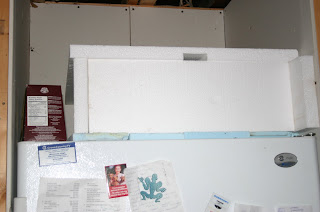
The curing is meant to produce a thicker skin on the sweet potato so it can be stored. When you dig them, sweet potatoes are easily bruised or damaged by the shovel, so treat them gently, more like a peach than a potato because any bumps or cuts will wound them and they will start to rot in the curing stage. One bad sweet potato can spoil the whole lot, so check them frequently and take out any that are going soft or mouldy.
Once I was sure they were cured, my basement is a constantly cool 15 degrees, at 60% rH, perfect for storage. The paper suggests that storing them in crates covered with barely moist sand will help stop the dessication I experienced last year. We still have half a yard of sand left over from the electrical trench we dug to the garage last February, so I used that and occasionally remember to mist the top of the sand lightly to keep it moist.
It has been two months since I put them in the basement, and so far they look the same as the day they went in. If all goes well in spring, I will pot them up in the green house and have lots of reclaimed plants for the street planters next year.

Thursday, December 16, 2010

Kingsport Water Project

A long long time ago, in a province far far away...
Well OK. It was 2007, and we were temporarily in Newfoundland.
We received notice from the county here at home in Nova Scotia, that they were considering installing municipal water along our road and requesting permission to a well water test as the first stage of a process to determine whether the area needed municipal water supplied.
Sure, of course we thought, and notified our tenants that someone would be around to take a water sample.
As a result we got a free water test in February 2008, something you should do every so often anyway, if you have a well. The results of the test for us were OK. We got a report that indicated nothing harmful in our well, but did note that we have higher iron than is considered aesthetically pleasing.
I already knew that because of the rust stains on my tub and shower and toilet.
In June that year, there was a public information meeting about a water project which we couldn't go to because we were in Newfoundland. They did send out the overall results of the area water tests, which I found shocking. Of 80 tested samples, 17 had higher than acceptable levels of something that would affect peoples health. In other words, about 22% of households in my neighbourhood had unsafe drinking water. Mostly it was bromine from the sea water infiltration, but some houses had coliform or selenium too. 13 houses like ours had high iron counts and 15 had high sodium counts.
What followed next was a number of meetings to decided if we wanted to fork out the bucks to pay for a water line installation and how much we would be willing to pay. The first proposal didn't include the whole area, and some residents felt left out. These meetings had a distinct "Gilmore Girls' quality about them.
The next proposal six months later in 2009, doubled the cost per household to about $10,000 and we all balked at that.
The third proposal changed some of the engineering to reduce the cost and the price came out to $6000. Then we were asked to commit to the project or not. To get funding from various forms of government, the project needed 40% of residents committed to paying the $6 grand. We had to commit by a certain date, just before Christmas. We didn't get the 40% because who has time to look at this stuff just before Christmas?
The deadline was extended, and eventually in early 2010, we got the 40%.
Then the proposal went to county council for approval, and to the various levels of government for infrastructure funding, some of it only available this year, as economy booster funds, from the feds. If we didn't start actually doing something this year we wouldn't get that funding and the cost per household would go back up to $10,000.
Then came the long process of the main pipe installation which lasted all spring, summer and into the fall this year. The project was supposed to be completed in September, and in August there was another public meeting to tell us that it would probably be October, but we could pay our money now.
We paid up, and started wondering when we would find time to get the lateral pipe to the house installed this fall. Then came another public meeting to explain to residents how that was supposed to work. Apparently everyone else hadn't done anything either.
Finally, on Dec 1, we had the lateral installed to the house. That looked like this.

And This.And This.
On the up side, Peter got to rent a really big tool and drill through the foundation (3 times until we got it right.)
We still have only well water though. The Village is refusing to take ownership of the project from the county until a few engineering kinks are worked out. To complicate the process, some residents who had committed to paying are summer cottagers who got tired of waiting around and left for the season. Until they pay, the village doesn't want to take on the maintenance because they don't have enough houses connected to make that pay.
On Monday we had a wicked wind storm that knocked out power for 24 hours. With a well, when we lose power we lose water. So close and yet so far.Three years and counting.

Thursday, December 9, 2010

December off to a bad start.

The first week of December seems to be cursed.
I was thinking this on Tuesday as I drove home from visiting Parrsboro, the town where I grew up and where my parents still live. I went for a funeral of a friend's grandfather. Listening to the radio in the car, I realized that it was the anniversary of the Ecole Polytechnique massacre in Montreal 21 years ago, where 14 women were deliberately killed and others wounded as they attended classes.
It was also December 6th that the Halifax Explosion occurred in 1917 killing 2000 people, wounding about 9000 more and devastating much of the city.
Last week, before I left for the funeral, I got an email from a friend who had had a very bad day where she ran out of heating oil, had to give away some ruined produce, lost some cash, had a car accident and needed to wallow.
Just last night another friend recounted her first week of December saying Monday she had a flat tire, Tuesday she hit a deer on the road, Wednesday her computer hard drive died and she lost everything, Friday her sink backed up and her vacuum blew up just before dinner guests arrived.
Today I opened my email to find two obituaries.
I'm sure there are good things going on somewhere, but it does appear that the first week of December is a rough time.

Tuesday, November 23, 2010

Acadia Christmas Craft Expo

Last weekend I attended the Acadia Christmas Craft Expo. I remembered to take a picture of the booth before the hoards arrived. Doing a craft show is a bit like doing theatre. The booth is the set (which in my case was a bunch of found objects, including a plant stand I picked out of big garbage this summer and some wooden boxes that normally hold our firewood) I have future plans for a professional looking shelves that my personal carpenter can design. He also doubles as a system engineer in planning the efficient packing and transportation of pots. I was amused to see that other exhibitors who do this all the time don't seem to have a system other than cramming various sized boxes haphazardly into the back of a minivan.
There is also lighting considerations and prop placement and presentation.

Notice the new sign. I had a graphic artist friend design the logo which I used on business cards too.We got lots of positive comments about it, and I'm pretty sure it helped to fool people into believing I was a real potter. My friend also does website design under the name Wingspan.
This was my first big craft show, it was three days long, and I was pretty nervous about the cost and the duration of the show. In the end, I took in more money than it cost me to be there so I was happy.
I was also worried that I didn't have enough stuff to exhibit. My attempts to make pots were disappointing because things kept cracking as they dried. I fired only one kiln before the show, and it over fired because the kiln sitter didn't shut off and I just kept waiting for it to drop instead of manually doing it myself. I chalk that one up to being overtired. Once I realized what was going on, I had visions of all my pots stuck to the shelves, but the glaze behaved very well despite my idiocy and only two pots suffered damage.This chip plate cracked on the edge of the bottom. I'm not sure that is a firing problem or a construction problem. It looked fine after the bisque fire, but the extra heat work in the over firing glaze kiln may have put too much stress on the bottom.This vase looked fine out of the kiln, but on day two of the fair the glaze started to flake off the shoulder, as if the pot contracted more than the glaze. Luckily, it was the only pot with that particular glaze.My fear about not having enough stuff to sell proved to be true. I sold lots on Friday and Saturday, but by Sunday the table was looking a little thin. We sold mostly butter dishes and mugs and vases the first two days. No bowls. By Sunday, those items were mostly gone and we sold four bowls. I observed the interesting phenomenon that no one wants to buy the last of something. As long as we had lots of a style of mug, we could sell them, but once there was only one of each style left, no one wanted the last one. Always have at least two of something so they can choose which one they want.
The other observation was that only other exhibitors appreciate coil built pots. The general public passes by them without a glance, but other exhibitors understand how much more work they are. I traded the red coil pitcher for some leather work at the end of the show. This is one of the benefits of going to a craft fair, you get to trade your stuff for other stuff which is gratifying because it means other people want your stuff. But also, in a lull, you can get your Christmas shopping done.
In all, it was a good experience.

Sunday, November 14, 2010

Laundry List of Fun and Exciting Things

Wow, I have a whole laundry list of fun and exciting things to write about. I've been so busy doing all these fun and exciting things that blogging was impossible. It is a real time commitment to do this regularly and I admire people who do, but I don't know where they find the time. Perhaps it is just me struggling to find the perfect phrase instead of just dashing off whatever comes out that makes it more time consuming that it should be.
Enough naval gazing. On with the list.

Just before my first craft show I attended an awesome workshop put on by the Nova Scotia Potter's Guild. They had Joan Bruneau of Nova Terra Cotta Pottery in Lunenburg do a 1 day workshop on how she alters and decorates her pots. I love the idea of altering thrown pots, but when ever I try it my pots just look lumpy and sad. Now I understand that when she alters her pots, she has a plan before she starts. Go figure. Lots of other potters were there including some potters that I didn't think needed to see any workshop, namely Ray Mackie from Lucky Rabbit Pottery, and Jim Smith from Chester. Yes, I'm name dropping. Going to a workshop like this is like watching the Brier on TV. You can see how it is done, you understand the process and you get really jazzed up to try it; and then you plunge into the depths of dispair when you realize that knowing and doing are different. I just don't have those skills yet.

Speaking of the Brier, October came and that means curling season again. You would think that after 7 months of professional gardening (not to mention the unprofessional hours put in at home); months spent bending and stretching and lifting and shovelling and pushing and carrying and raking, that the little matter of sliding around on ice and doing a bit of sweeping would be no problem. It is not like I spent the summer drinking beer (well yes OK I did that too.) I am a pretty active person. But apparently for all the muscle groups I use in the summer, gardening and swimming and well, drinking beer, I did not use the muscle groups required to slide out of the hack 16 times and sweep 48 rocks in two hours. My work colleagues got some amusement watching me groan about the first week. For some reason, climbing in and out of a truck seem to be the worst, and I only do that about 50 thousand time a day. Life was complete madness on those overlapping weeks when I was starting to curl twice a week, preparing for and going to craft shows and still working. Happily I stopped work and now all is fine.

The parks department finished work last Friday, one day before my second craft fair. I sold the same number of pots as the first show: three, but as Peter wasn't with me to buy things and lunch was catered, I came out $19 ahead. Whoo Hoo! I am, however still learning who buys pottery. I can tell you that women with small children DO NOT buy pottery, because they cannot justify spending money on a beautiful object that will get broken when Walmart sell those object in plastic or metal for less. This is as good a reason for not having children as I have ever heard.

That show was also in the middle of a terrible rain storm that went on for 5 days, flooding south west Nova Scotia and washing out roads and bridges in many communities. It was not a hurricane although the winds on Friday were higher than during those so called hurricanes we had this year. We were untouched, but I was constantly amazed at how full the rivers were last weekend. Our Habitant River, normally a ditch with barely a trickle of water, was 25 feet wide and probably as deep. Even in the spring melt I have never seen it so high.

This was also the weekend my dear parent- in-laws came for a visit. They had been attending a reunion in Fredericton at the University of New Brunswick and popped over here before heading back to British Columbia. At this time of year, we could have easily been under snow or at least experiencing freezing weather, so 5 days of rain is not so bad. Except the wind and rain cancelled all flights into the airport and they were delayed 24 hours before they arrived. Had they known, they could have driven the distance in a mere 6 hours. It was dismal and gloomy for their visit throughout, I don't think they miss this coast at all.

My next hurtle is the 3 day craft fair at the end of this week. Since the parent-in-laws left I am potting full time, in a crazy push to get things through the entire process so I have some fresh new things for the show. Typically perhaps, the full time push has meant that my pots are drying much more quickly as I am leaving them uncovered to hurry them along. Consequently my pots are developing stress cracks in the bottoms. I had to recycle two vases yesterday and one chip and dip plate today. I suspect a large bowl and a small casserole will be next. At this rate I may have nothing at all to fire which will certainly free up some time. It's frustrating because stress cracks are not usually a problem for me, but I've been going through a phase and some of my bowls came out of the last glaze kiln with cracks too. I have had to bag up the remaining pots to prevent them drying too fast and therefore I have nothing to do, so today, instead of pottery I mowed up the leaves on the driveway and watched a movie. It was like a forced day off. The forced slow down may mean nothing gets finished before the weekend.